Ecology of the Red Fox
Few native species divide opinion as deeply as the red fox. Despite being voted the third most popular British mammal in a recent BBC Wildlife survey, foxes still face widespread demonisation and persecution. A better understanding of fox ecology and behaviour – and the essential ecological role they play – can help dispel the myths and misconceptions about this iconic British species. The red fox (Vulpes vulpes) is the most widely distributed wild carnivore on the planet. It naturally occurs across North America, Eurasia and Japan, and even as far north as the Arctic Circle. It has also been deliberately introduced (and thrived) in other regions such as Australia by English colonisers for the purpose of fox hunting. This widespread global success is due to the fox’s incredible adaptability
living in habitats as diverse as tundra, forests, deserts, wetlands and cities, and eating a huge variety of food types.
Foxes are omnivores and will eat pretty much anything – from rabbits, field voles and berries, to earthworms, insects, and fruit. In cities, they take advantage of human handouts, compost heaps, bird tables and unsecured dustbins, as well as preying on rats. However, foxes don’t waste food. If they find or kill more than they can eat at one sitting, they bury (cache) the food to eat later. This noble trait is responsible for the myth that foxes ‘kill for pleasure’. When confronted with a flock of hens, foxes will kill as many as possible with the intention of burying those they can’t eat straight away and storing them for leaner times.
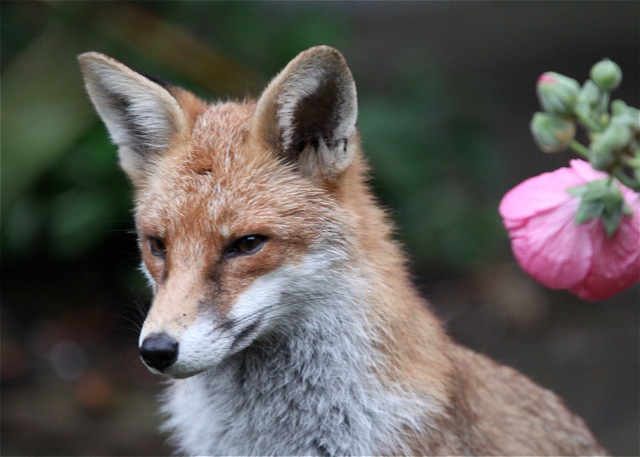
The red fox varies in size and colour across its wide geographic range. In Britain, the average fox is only slightly bigger than a pet cat. They are far too small to tip over a dustbin full of rubbish as is often claimed. To scavenge from bins they jump on top and knock the lid off. This is easily prevented by using bins with locking lids or securing the lid with a bungee cord.
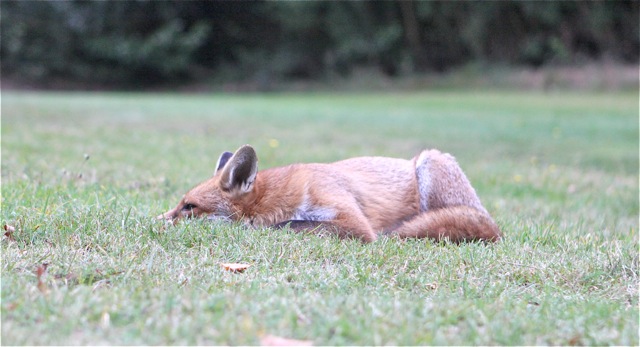
Foxes sleep and breed in holes called earths. Sometimes they dig the hole themselves, but they also use old badger setts, hollow trees, and spaces under garden sheds. Although captive foxes can live for up to 14 years, similar to domestic dogs, wild foxes rarely live more than a few years. Cars are the biggest killer of foxes in Britain.
A female fox is called a vixen; a male is called a dog. They mate in mid-winter and vixens give birth between March and May. The 4-5 cubs are born deaf and blind with short black fur and blue eyes. They do not leave the den for several weeks and are dependent on their mother’s body for warmth and their father to provide food for the family. Male foxes are attentive dads, playing excitedly with their pups and bringing food home for the whole family.When it’s time for the young foxes to start finding their own food, the dad hides food nearby, helping teach the cubs to sniff out a meal. Most cubs leave their parents in early autumn to search for their own territory. Few are successful and most die before reaching 10 months old.
The dominant male and female fox form a pair that often lasts for life. Although they hunt and feed separately, they regularly meet to groom each other and play. Some young foxes also stay with their parents for a few years and help raise future cubs. Like all families, communication is essential to foxes. They use at least 28 different types of calls to communicate with each other as well as facial expressions and body posture similar to domestic dogs, like wagging their tail when they greet family members.
Breeding foxes hold territories year-round. By marking their territory boundaries with urine and faeces, foxes learn the smells of their nearest neighbours. When two neighbours meet, the encounters are usually peaceful. When strangers meet, the encounters can be more aggressive.
There are always more foxes around than suitable breeding territories so some foxes, particularly young ones who are dispersing from their parents’ territory, spend their time on the move looking for a vacant territory to occupy. This is why trying to reduce fox numbers by killing them is pointless. A dead animal simply leaves an empty territory that is filled by a new fox within 3-4 days, Most local authorities recognised this years ago and abandoned ineffective and costly lethal fox control. Instead, most now provide free advice on deterring or excluding foxes from properties as this is the only long-term solution to human/wildlife conflict.
Annual surveys show that rural fox numbers have remained stable at around 225,000 adults for the past decade. This is good news for farmers – by feeding on rabbits, the staple diet of rural foxes, they save British crop farmers between £7-9 million every year. In its lifetime, one fox is worth up to £900 in extra revenue to arable farmers. Foxes also help woodlands grow by feeding on field voles and rabbits, the species that do the most damage in young plantations, foxes help reduce economic losses to forestry, yet foxes continue to be used as scapegoats by some livestock farmers. This is clearly unjustified. According to Defra, 95% of lamb losses are due to poor farming practices, with confirmed losses to foxes less than 1%.
Urban fox numbers are holding steady at 33,000, although bad human habits may be causing an increase in fox boldness. In an increasingly urbanised world, adaptable species like foxes provide an important connection to nature for many people. A survey in Bristol revealed that 10% of residents regularly feed foxes even though each fox territory had at least 150 times more food available than is needed by each fox. In other words, people feed foxes for their own benefit, for the pleasure they get out of seeing and interacting with this beautiful animal, not to help the foxes survive. As the natural world disappears before our very eyes, versatile and adaptable species like foxes provide the only encounters with wildlife that many people get.