

Inwood
Woodland Restoration
This page will show the latest information on works carried out in the woodlands.
Please email info@savemetrust.org for any further updates
1st November 2023 the Felling of Ash Trees.
Conservation and Maintenance works are due to start on 13th December for approximately 2 weeks.
Inwood has been and still is being impacted by Ash Dieback Disease (Hymenoscyphus fraxinea). This ultimately leads to tree death resulting in dangerous trees and is a significant threat to woodland sustainability. Ash trees are being selectively felled to mitigate the impact of the disease and allow further planting to establish replacement trees as soon as possible. After initial felling we have now discovered more infected trees and these will now be removed. .
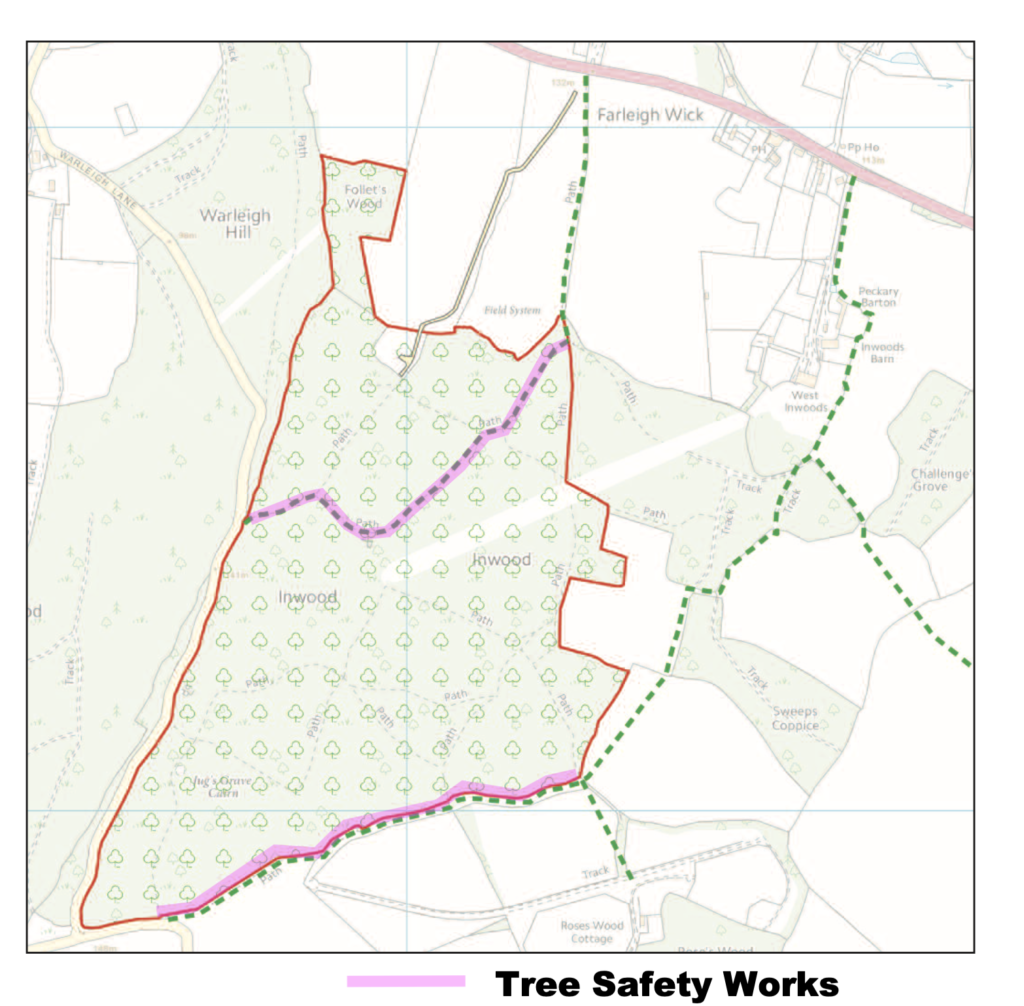
The map above shows the dangerous ash trees that we hope to start felling w/c 13th December to reduce the risk of dying trees falling over the public right of way. Also attached is the public notice last employed to inform people of the works along the paths. This is out of our control, but as soon as the shutdown is confirmed we will need to start the felling. We are expecting confirmation for January. These warning signs will be used . The felling will take place outside of bird nesting season and felled infected trees will be removed . We are replacing the ash with other native broadleaf trees to promote woodland sustainability and native biodiversity.
MEASURES TO ENSURE PUBLIC SAFETY
• Please keep to the public footpaths and follow all directions and signage.
• Please do not enter worksites while the signs and barriers are up.
• Please do not remove signs or barriers – these are here for public safety and you could be risking serious injury to yourself and others!
We receive regular complaints of dog fouling and anti-social dog behaviour in the woodlands. We respectfully remind you to abide by the law while using the permissive access that we have granted on this private land. We ask that you keep all dogs on their leads and clean up any fouling. Please do look at the law below in relation to dog behaviour and fouling. This page was written by a dog lover who has three dogs!
Dogs Behaviour & the Law
It’s against the law to let a dog be dangerously out of control anywhere, such as:
- in a public place
- in a private place, for example a neighbour’s house or garden
- in the owner’s home
The law applies to all dogs.
Your dog is considered dangerously out of control if it:
- injures someone
- makes someone worried that it might injure them
A court could also decide that your dog is dangerously out of control if either of the following apply:
- it attacks someone’s animal
- the owner of an animal thinks they could be injured if they tried to stop your dog attacking their animal
Penalties
You can get an unlimited fine or be sent to prison for up to 6 months (or both) if your dog is dangerously out of control. You may not be allowed to own a dog in the future and your dog may be destroyed.
If you let your dog injure someone you can be sent to prison for up to 5 years or fined (or both). If you deliberately use your dog to injure someone you could be charged with ‘malicious wounding’.
If you allow your dog to kill someone you can be sent to prison for up to 14 years or get an unlimited fine (or both).
If you allow your dog to injure an assistance dog (for example a guide dog) you can be sent to prison for up to 3 years or fined (or both).
Dog Fouling & the Law
Dog fouling – whether loose or bagged – is offensive, disgusting and a potential health hazard. It is a widespread problem, but sometimes changing the behaviour of just a few thoughtless dog owners can make a big difference.
Not only is dog mess unsightly, smelly and a nightmare when trodden in, but it’s actually a lot worse for the environment than people realise. It’s full of nasty bacteria and parasites that can be harmful to local wildlife and it can easily affect nearby water supplies as well.
Cleaning up after your four-legged friend is part and parcel of being a responsible dog owner, so take some pride in your surroundings and stop giving other more considerate dog owners a bad name
There are approximately 9 million pet dogs in the UK. One in four households in the UK has one, and they produce 1,000 tonnes of poo a day, or 365,000 tonnes a year
If a dog fouls in a public place, by law, the owner or the person in charge of the dog at the time must clean up after it. Burying, covering it up or hanging a poo bag on a tree is not sufficient; it must be removed.
The penalty for not clearing up dog fouling can be up to £1,000.
If not cleared up immediately, dog waste can infect soil and sand with a variety of worms than can be passed to humans, especially children, and cause illness- even blindness. These include tapeworm, hookworm, whipworm and roundworm. Children playing are more likely to touch the ground and risk infection. Contact with dog excrement can cause toxocariasis – a nasty infection that can lead to dizziness, nausea, asthma and even blindness or seizures
Under the Environmental Protection Act 1990, it is also an offence to allow large quantities of dog waste to accumulate in your garden. Small amounts of dog waste can be disposed of in domestic refuse, as long as they are in a sealed bag.
This was written by a dog lover who has three dogs!