

A recently publication in Nature Scientific Reports (see below) has been used to make claims that the badger cull has led to a 56% reduction in the incidence of bovine tuberculosis. This headline is clearly stated in the paper, written by the staff of APHA Weybridge, but it is a misinterpretation of the analyses of the study, and a gross distortion of the actual effects of the badger cull.” The 56% figure is taken from a paper published by Birch et Al in Nature Scientific Reports, submitted in September 2023 and published in February 2024. All the authors are employees of APHA, an executive agency of DEFRA, and the work was funded by DEFRA. The study is a desktop review of APHA testing data using novel statistical methods to determine any reduction in TB prevalence in cull areas.
The study openly states that there is no way of comparing TB prevalence in areas where there was culling and areas where there was not, which would give a more reliable comparison.
To be fair to Birch, he clearly states the limitations of his study, but not in the introduction / abstract. People rarely get further than this because it becomes very technical. I would always ask critics “Have you read the paper?”, and if they claim that they have, ask them what they thought of the inclusions and exclusions from the analysis – that will bring quizzical looks from those who didn’t get further than the abstract. In particular, check that they understand the difference between OTFW and OTFS, as this is a key weakness of the data analysis.
The abstract clearly states that The herd incidence rate of TB reduced by 56% (95% Confidence Interval 41–69%) up to the fourth year of BCP interventions, with the largest drops in the second and third years.
However, just a little later in the same paragraph, it states: These estimates are the most precise for the timing of declines in cattle TB associated with interventions primarily targeting badgers.
Key words here are:
Herd incidence rate: there is no definition, but the paper clearly states that they only used herds with OTFW (confirmed outbreaks) within this headline rate. These are incidents of TB where one or more of the reactors have visoible lesions at PM, which are then cultured to show M.bovis. Most herds are OTFS, and these were excluded from this data set. The paper explains that there were too many confounding factors if they included OTFS herds, including better testing, more robust surveillance, better biosecurity, more use of gamma etc. They fail to realise that the dramatic fall in OTFW is most likely due to these factors, and was already occurring before culling started! They do point out that Gamma testing was introduced into herds in the culling zones as a policy measure in 2017, and the study is unable to separate the effects of this from culling. (but it might easily explain why the drops in incidence are highest in the second and third years!! Half of all reactors in the SW are detected by Gamma testing, but very few have lesions as the test finds them earlier in the infection progression – before the stage that they develop lesions.
Timing of declines associated with: association is not causation. The paper makes this very clear, and like all other studies, states that more work is needed to define causation. 80% of people die in bed, but banning beds will not prolong life.
The changes in herd incidence of bovine tuberculosis in the three counties of Dorset, Devon and Cornwall.
A recent publication in Nature Scientific Reports (Birch et Al 2024) has been used to make claims that the badger cull has led to a 56% reduction in the incidence of bovine tuberculosis. This headline is clearly stated in the paper, written by the staff of APHA Weybridge, but it a misinterpretation of the analyses of the study, and a gross distortion of the actual effects of the badger cull.
Whilst the raw data used in the calculations reported in the publication are not provided, nor publicly available, the readily available published data sets from DEFRA give a different picture of the effects of badger culling, clearly demonstrating it ineffectiveness.
Background information
All herds that are Officially TB Free (OTF) are subjected to routine surveillance testing using the Single Intradermal Comparative Cervical Test (SICCT) Tuberculin Test. When reactors are disclosed by this test on individual animals in a herd, the whole herd has its OTF status suspended (OTFS), whilst any reactors are removed, slaughtered and the carcasses inspected for the presence of visible lesions of tuberculosis.
Should lesions be visible at postmortem inspection, samples are taken and tested in a laboratory for the presence of Mycobacterium bovis, and if confirmed, the status of the herd is redesignated at OTF Withdrawn (OTFW). If no lesions are visible, or M.bovis is not confirmed, then the status is maintained as OTFS, and restored to OTF once two clear SICCT tests have been completed.
The specificity of the SICCT is very high, and we can be confident that both OTFS and OTFW herds are truly infected with bovine TB. The designation of OTFS and OTFW is based on tradition and a discredited belief that confirmed reactors are likely to be more infectious, and so OTFW herds should be treated with more concern. However, the presence of visible lesions in reactor cattle has no real significance other than suggesting the age of the infection, as lesions develop in the later staged of the disease. Early infections, without lesions, can be just as infectious and unconfirmed reactors reliably indicate the presence of infection within a herd.
The three counties: Dorset, Devon and Somerset
Most bovine tuberculosis infections occur in specific geographical locations: the three counties of Dorset, Devon and Cornwall contain 35% of all the bTB infected herds in England, despite having only 18% of the herds. Badger culling has been ongoing in over 80% of the land area of these three counties since 2018, in an attempt to control the infection. Other measures have also been introduced during this period, including more robust and frequent SICCT testing supplemented with the use of Gamma Interferon blood testing in infected herds, enhanced biosecurity, and stricter movement controls.
The incidence of bovine tuberculosis in these three counties is well recorded and data is readily available through DEFRA data sets. These data give a realistic and credible measure of the success of all bTB controls introduced in recent years, including extensive culling of badgers.
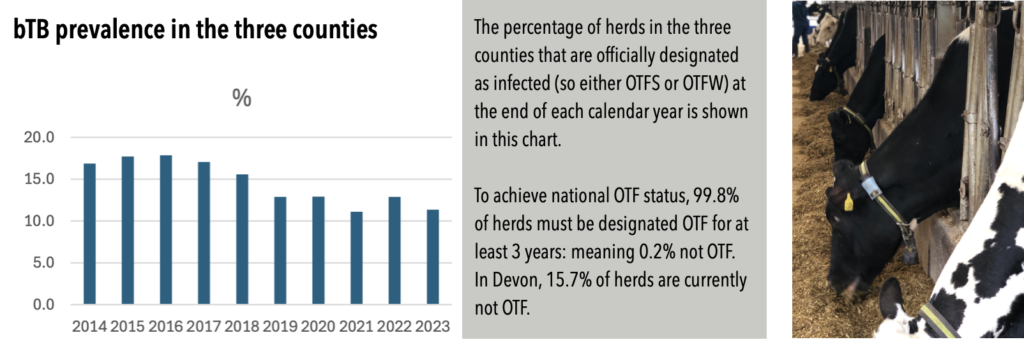
The chart shows clearly that the incidence of bTB infected herds in the three counties has not fallen by 56%, as claimed by some who have extracted the headline conclusion from the Birch paper. Despite all the bTB controls that have been applied, including the widespread culling of badgers since 2018, the reduction in infected herds has been minimal and was mostly between 2016 and 2019, before badger culling was established throughout the area.
A significant change has occurred in the incidence of reactor animals that have visible lesions at post mortem inspection, with a major reduction in the proportion of infected animals disclosed by the routine surveillance testing that are classified as confirmed by the presence of visible lesions and the presence of M.bovis.
Dorset Devon Cornwall | Number of reactors disclosed by routine standard SICCT testing | Percentage of reactors that had visible lesions (VL) | Percentage of reactors with no visible lesions (NVL) | OTF herds which had their OTF status suspended (OTFS) | OTF herds which has their OTF status withdrawn (OTFW) | Total infected herds |
2019 | 12199 | 43% | 57% | 466 | 625 | 1091 |
2022 | 8608 | 29% | 71% | 631 | 434 | 1065 |
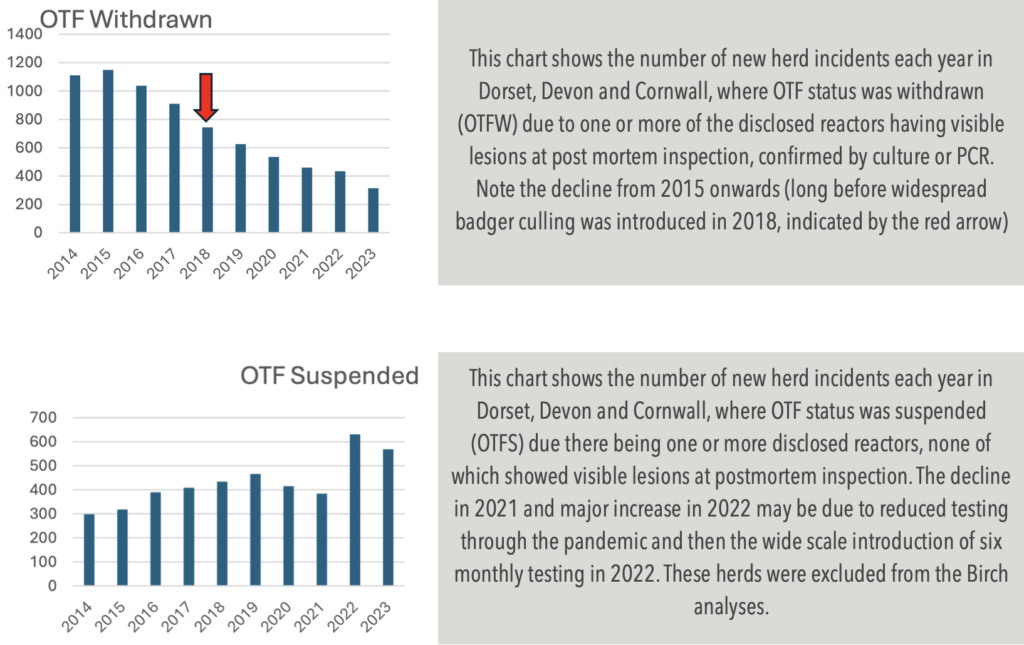
This significant fall in the number of confirmed outbreaks (OTFW) in herds in the htree counties was mirrored by an increase in the number of unconfirmed outbreaks (OTFS) The number of infected herds remained about the same, despite widespread badger culling in over 80% of the land area.
This significant reduction in the number of infected animals with visible lesions, associated with the reduced number of confirmed bTB breakdowns designated OTFW, was undoubtedly due to the increased frequency of testing, more robust testing protocols, and the intensive use of gamma interferon. This welcome change in testing policy resulted in finding infected animals earlier in the bTB infection progression, and so reduced the number of late-stage infected animals with lesions: they were disclosed and slaughtered before lesions developed.
This trend of reducing OTFW herds and increasing OTFS herds had been going on for some time, long before widespread badger removal operations were introduced in these three counties: the charts below illustrate the trends:
Conclusions
The paper published by Birch et al, published in Nature Scientific Reports (2024) and written by staff of the APHA, made a headline claim that there had been a 56% reduction in herd incidence associated with badger removal operations in specific areas withing the high risk area. The number of herds and the geographical locations are not described.
OTFS herds were excluded from the analysis, for reasons explained in the paper, so the conclusions are based on the reduction of OTFW herds only. This skews the reality and ignores the majority of herd breakdowns and the overall herd incidence, although gives a headline conclusion that suits any narrative of the effectiveness of badger culling.
Any headlines or claims derived for the study and the complex statistical analyses should make clear that badger removal operations may be associated with a 56% reduction in the incidence of OTFW herds, but the overall herd incidence in the main areas of badger removal operations has changed little, with a significant increase in the incidence of OTFS herds.
It cannot be definitively known if this change in OTFW herds is due to badger culling as claimed by Birch et Al, or more likely due to the changes in testing policies and biosecurity requirements that had been introduced at the same time.
Questions to be asked to those who make claims derived from this paper:
- Why were OTFS herds not included in the data set, as they represent most of the herd breakdowns and represent the true herd incidence of infected herds in the HRA?
- If there is a suggestion that TB breakdowns that are disclosed by positive skin reactions, but where the reactors have no visible lesion, are not significant and may not be a true indicator of bTB infection, then the testing policy must be questioned: in 2022, 71% of all reactors disclosed by the standard skin test had no visible lesions (up from 57% in 2019). Were these animals not infected with bTB and were therefore slaughtered unnecessarily, and the herds restricted for no reason, or were the tests accurate and the herds truly infected, in which case they should be included in any analyses?
- How can this reduction in OTFW herds be attributed to badger culling operations when there were much more significant tuberculosis controls introduced over the period of the study in the areas included in the data set, including increased frequency of testing, more robust testing protocols, increased use of gamma interferon, and robust biosecurity requirements?
- Why has the incidence of OTFS herds increased in the areas where badger culling operations have been most intense and over the longest periods?